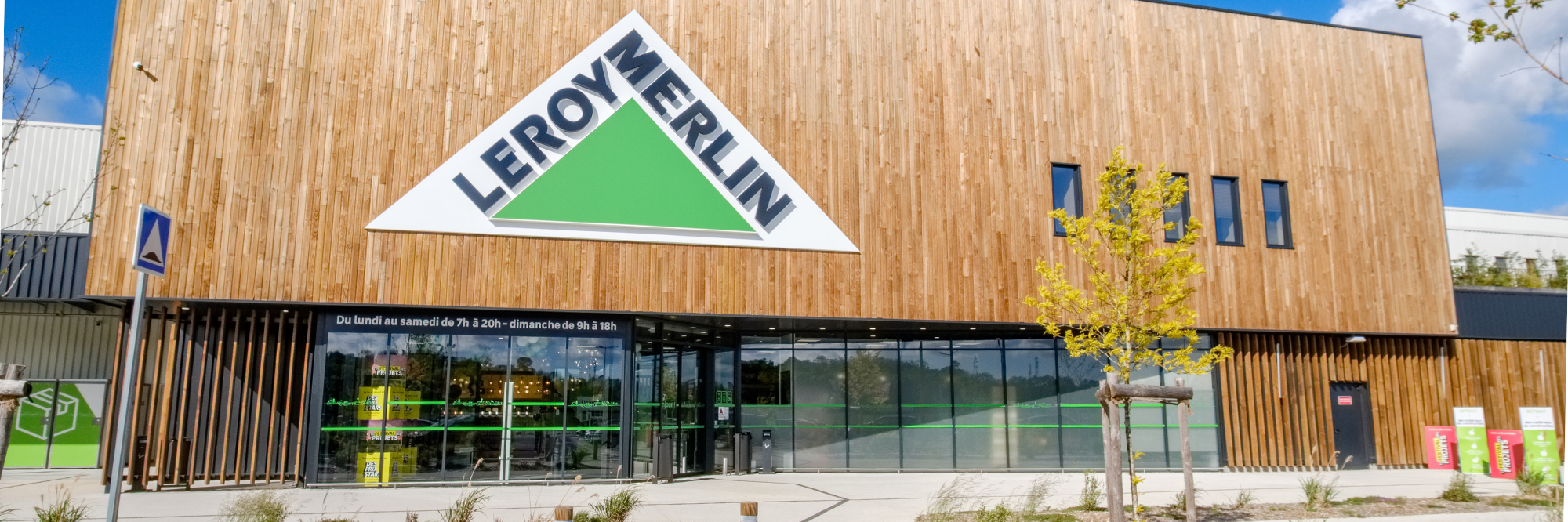
Retail: How Leroy Merlin optimizes the ROI of its business investments with AI
A DIY heavyweight with revenue close to 10 billion euros. Four years of transaction data. 40,000 AI models running in parallel. And, as a consequence, a simple yet challenging question: When I invest a euro in my sales levers, am I actually adding value, and where?
This is the challenge that Leroy Merlin rose to, in collaboration with Ekimetrics’ teams. Jean-Baptiste Niepceron (Data & Customer Knowledge Manager at Leroy Merlin) and Renaud Caillet (Partner at Ekimetrics) shared a behind-the-scenes glimpse of this project at an event in Paris. Here are the key takeaways:
The retail sector under pressure: an ongoing crisis that demands a new approach
Covid, the boom then the collapse of real estate, the war in Ukraine, inflation, the rise of pure players, fierce competition from discount stores… Retail isn’t going through one crisis; it’s in a state of ongoing crisis. And each new disturbance makes sales management a bit more complex.
For Jean-Baptiste Niepceron, there’s no escaping the facts: “One crisis follows another. Plans we draw up for three years have to be reviewed regularly. You have to be flexible and adapt.”
The growing fragmentation of buyer journeys amplifies this management challenge. Consumers now have an unprecedented range of choices: brick-and-mortar stores, marketplaces, specialized agents, preloved, discount brands, or digital platforms. This increase in touchpoints makes behaviours harder to predict.
In this context, there’s a strong temptation to indulge in promotional one-upmanship by lowering prices or increasing discounts. But this approach has a clear limit: without knowing precisely where to create value, increasing your sales investment budget is like operating blindly, running the real risk of destroying as much value as you create.
The real problem: too much data, not enough decision-making
This is one of the widespread paradoxes in modern retail. Companies have never had as much data or as many tools, yet decision-making remains predominantly intuitive and compartmentalized at different levels of the organization.
With business investments spread across distinct teams—media, promotions, loyalty, pricing, acquisition, sales events—each lever is still managed individually, without an overview of its actual contribution to value creation. “Teams find themselves buried under data, and no one really has a holistic view. The real question is: how do we move from data analysis to decision-making?” explains Renaud Caillet, Partner at Ekimetrics.
Jean-Baptiste Niepceron draws the same conclusion on the brand side: “We had the right ideas, some figures, but we didn’t incorporate it in a 360-degree manner. Everyone was looking at their own analyses, without being able to link them.” In other words, companies know how to quantify what has already happened. Understanding why, with which levers, on which customers, in which regions, and at what intensity, is considerably more complex. This is precisely the gap that Leroy Merlin decided to bridge.
The project: Model the actual impact of each euro invested
At the end of 2024, Leroy Merlin readjusted its sales strategy: changes in pricing strategy, loyalty program redesign (adding the Leroy & Moi+ paid option), streamlined promotional campaigns, enriched customer knowledge.
Yet beyond structural changes, one question remained unanswered: Can we actually measure the value created by each sales investment? For years, certain categories and promotional offers received sizable budgets, as much out of habit as by conviction. Without a robust measurement model, it was impossible to know whether these investments were creating value, nor for whom. The project therefore set itself two goals:
- Measure the precise ROI of each promotional lever
- Put the client back in the center of budgetary trade-offs
To achieve this, Leroy Merlin and Ekimetrics co-created an AI model with the business teams that models the impact of each promotional lever on financial metrics (such as revenue or margin) as well as customer value. The model relies on data from transactions, stores, digital platforms, and loyalty programs, including several years of sales receipt activity.
The scope: 13 business levers (loyalty program, national promotions, local initiatives…), approximately 200 product subcategories, several customer segments, and 11 regional zones, all based on four years of transaction data since 2022. The result: 40,000 unit models that run in parallel for 48 hours at each quarterly sales refresher training.
What distinguishes this approach from a simple statistical correlation? The co-creation with business teams of a causal graph. No black box. Each variable embedded in the model has been validated by those who engage in business daily. “The inputs that we’ve entered are business inputs. For me, not everything can be explained by a statistical model, so we made sure we had high explainability for the users ”, specifies Jean-Baptiste Niepceron.
For brands that want to take the plunge, switching from measurement to simulation, from analysis to real-time trade-offs, Ekimetrics has developed a service designed for profitable and sustainable growth that specifically incorporates this type of allocation scenario.
👉 Discover our Profitable Sustainable Growth solution
The results: Validated intuitions
First learnings: Leroy Merlin’s major business insights were generally correct. Nothing revolutionary, but the brand took away something rare and precious: evidence. “We didn’t discover that we were making the wrong decisions. More importantly, we put figures on intuitions that we already had. The answer to the question ‘Are our decisions creating value?’ was yes”, explains Jean-Baptiste Niepceron.
4 equally key learnings:
- The premium loyalty program, a decision backed by numbers: After offering a paid-for card for a long time, then opting for a completely free program, Leroy Merlin decided to reintroduce a paid option. The model confirms this: the ROI of this new option exceeds that of the old paid-for program by +30%, a decisive confirmation of a strategic choice that could have remained a conviction without evidence.
- Personalization, a real performance lever: Historically, Leroy Merlin reached out to customers without distinction. Analysis confirmed this with one figure in particular: When offers are tailored for “project” customers (those who are renovating their home, with a value 3 times higher than a classic customer) with marketing communications that are personalized and contextualized to their life cycle, the ROI gain reaches up to 60% compared to generic promotions.
- Local initiatives justified: Promotional campaigns initiated by stores in their zone generate real value, slightly less than for national campaigns, but enough to justify and encourage local autonomy, which is important in Leroy Merlin’s brand culture.
- Regional disparities call for differentiated trade-offs: Certain geographical zones respond better to promotional levers than others. Île-de-France, for example, with its high concentration of professional customers, has performance mechanics that are distinct from the rest of the country.
The human factor: The toughest part of the marathon
Technically, the model runs. The results are there. Jean-Baptiste Niepceron is clear on this point: “We’re at the thirtieth kilometre of the marathon. What we produce needs to be used. That’s the most decisive part of my work. We’re here to challenge ways of thinking, ways of using information. When we’ve finished the model, we’re halfway there.”
Adoption is the real challenge. Ekimetrics embedded adoption into its approach from the start: Every stakeholder (product managers, performance teams, management accounting, regional management) was involved, with their own perspective, indicators, and input into the results.
A simulator was built to translate insights into decisions. Users tested budget allocation scenarios (“If I spend €150,000 rather than €100,000 on this category, how much added value do I generate?”) without re-running the 40,000 models.
The next stage under consideration goes even further: allowing users to analyze the results in natural language without using a technical interface. Specifically, a department manager will be able to ask a question directly, “How effective were my gardening promotions in the north this quarter?” and get a clear answer without having to navigate through data tables.
3 key success factors to keep in mind
- Data maturity takes years to build. Leroy Merlin didn’t start this project in 2024. Data collection, storage, and structuring at the ticket level go back several years. Without this base, it’s impossible to have such a finely tuned, actionable analysis.
- Co-creating with business teams is mandatory. Armchair data scientists didn’t deliver the ready-to-use model. It was created with the teams who monitor the markets daily, to avoid the black box, and to ensure adoption. As pointed out by Renaud Caillet: “The most difficult topic is still adoption. That’s where the real transformation happens.”
- The drive comes from above; adoption comes down to the details. Leroy Merlin benefits from management that explicitly promotes a data-driven decision-making culture. But this drive isn’t enough: The work on the ground, training, simplifying interfaces, and educating about results make the real difference.
Data, AI, instinct: the new equation of performance retail
Facing inflation, a price war, and growing pressure on margins, brands can no longer manage their investments based solely on intuition or rely entirely on algorithms. Value creation now stems from the convergence of business expertise, data quality, and artificial intelligence.
The real issue is no longer knowing how much data a company has. It’s knowing how many decisions it can improve thanks to that data.
“AI is a real driver for making decision-making more inclusive. But the challenge is to use it with a specific purpose—not to do it for the sake of it.” hammers home Renaud Caillet.
It’s not the end of commercial instinct. It’s supporting it with evidence. And it could be the only sustainable competitive advantage in a retail sector under permanent pressure.
To dive deeper: 👉 Understand Marketing Mix Modeling