How Eurostar strengthened its brand awareness and optimized train occupancy thanks to Ekimetrics’ Marketing Mix Modeling
After merging with Thalys, Eurostar faced a dual challenge: unifying its brand identity and managing media investments in a market reshaped by Brexit, post-Covid shifts, and new competition. By relying on Ekimetrics’ Marketing Mix Modeling (MMM) and its One.Vision platform, the rail operator transformed its marketing strategy into a long-term business growth driver.
Why brand awareness became a key priority for Eurostar
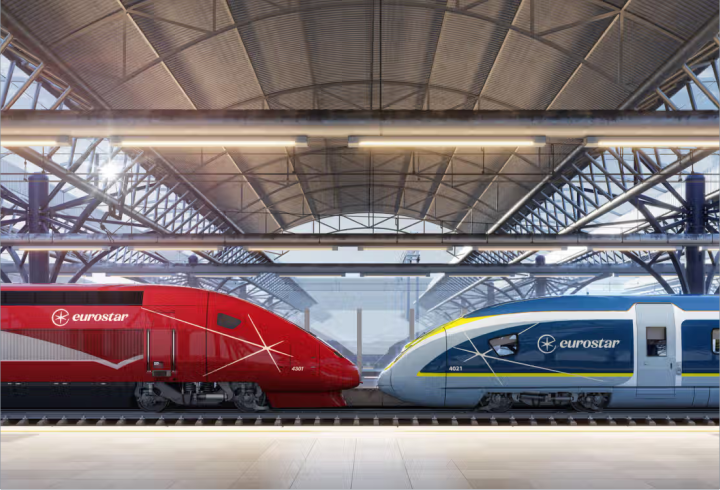
For years, Eurostar was primarily associated with its iconic Paris–London route. But since its merger with Thalys in 2023, the brand now spans a much broader European network, extending across France, Belgium, the Netherlands, Germany, and the UK. This change in scope required a strong repositioning. Three priorities were defined:
- Establishing a unified brand, winning over travelers on the continent who were still attached to the Thalys name
- Building awareness around new leisure destinations, to attract weekend leisure customers, and not only the core business travel audience
- Maximizing train occupancy during off-peak periods to sustain growth and fund fleet expansion
How Ekimetrics adapted its MMM approach
Eurostar was no stranger to Marketing Mix Modeling—the company has partnered with Ekimetrics since 2008, marking more than 15 years of continuous collaboration. This maturity made Eurostar an advanced player in data governance and value creation. Yet, in this ever-evolving environment radically reshaped by Brexit and Covid, Eurostar and Ekimetrics needed to rethink their modeling framework to stay relevant and support the brand’s evolution. In 2024, a broad media investment scope was analyzed across three key markets—France, the UK, and Belgium—to deliver a comprehensive and coherent view of performance. The methodology was refined around three core pillars:
- Reconfiguring models to integrate major disruptions: The models had to be completely redesigned to absorb three defining events: the post-Covid recovery and the gradual rebuild of natural demand, the Thalys–Eurostar merger that required harmonizing disparate data sources, and finally the Paris 2024 Olympics, which disrupted travel behaviors and called for targeted, cyclical media strategies—especially in the UK, where Eurostar sponsored the British team.
- Rethinking media governance in a new ecosystem: The merger brought a team reorganization, with new market leads and more complex coordination needs. MMM became a shared decision framework, offering a rational and unified view of performance. It also helped bring the media agency fully into the process via One.Vision, enabling real-time simulations and collaborative planning—including the design of the 2025 media plans.
- Balancing short-term performance and long-term brand equity: In a context of financial pressure and ROI scrutiny, MMM became a compass. It quantified the enduring impact of brand-building investments against the temptation to focus solely on performance-driven channels. This capacity to objectify trade-offs gave the marketing teams concrete arguments to present to finance departments.
Result: This progressive reconfiguration ensured the MMM’s robustness through major external shocks and provided marketing teams with a clear, consistent view of media effectiveness across highly dynamic contexts.
Building the awareness of a unified brand
Following its merger with Thalys, Eurostar can no longer be limited to its perception as a “train to London”. Its challenge is much more far-reaching: to build recognition as a single, unified brand across its European network—from Germany to the Netherlands, Belgium, and France.
In this context, brand awareness campaigns are essential. Twice a year, Eurostar launches large-scale media activations designed to build top-of-mind awareness among leisure travelers as well as business audiences. These high-investment, high-stakes campaigns required precise measurement to prove their real business impact.
MMM has enabled objective assessment of this long-term effect:
- Introducing a multiplier coefficient to assess the sustained contribution of brand investments to natural demand, over a 6-month to 2-year horizon.
- Demonstrating that brand awareness remains a structural growth driver, even under financial pressure, favoring short-term performance channels.
Through these insights, Eurostar could confidently defend its brand-building budgets while fine-tuning media strategy.
“Our awareness campaigns are essential to position Eurostar as a truly European brand—not just a train to London. MMM finally allows us to measure their real impact and secure long-term investment.” Chris Ford, Eurostar Media Lead
Filling trains: A strategic challenge powered by data
Beyond awareness, Eurostar also had to tackle a tangible business challenge: maximizing train occupancy, especially during off-peak periods. This is where MMM proved particularly valuable. By integrating revenue management variables, the model measured the real impact of pricing decisions combined with media activations. This enabled Eurostar to pinpoint the most efficient levers to drive incremental sales when trains were not at full capacity.
A decisive advantage is that it has its own e-commerce platform, unlike other rail operators that rely on third-party distributors. This gives the company the possibility to directly manage its digital performance and monitor customer experience from start to finish. The MMM insights helped optimize this channel by connecting digital investments more precisely to actual ticket sales.
MMM thus became not only a brand strategy tool, but it also strengthened Eurostar’s capacity to fill trains during off-peak periods while maintaining strong average revenue per seat.
“Thanks to the insights, we know exactly which levers to activate to fill our trains during low-demand periods without compromising ticket value. It’s a balance we couldn’t have achieved without MMM.” Chris Ford, Eurostar Media Lead
What tangible results did Eurostar achieve?
Within the first years of implementation, the new MMM approach delivered measurable outcomes:
- Precision in brand awareness steering: Both annual awareness campaigns were optimized, with their long-term effects quantified and integrated into the global strategy.
- Higher occupancy rates during off-peak periods: Through smarter budget allocation, Eurostar strengthened direct sales on its own website—a key competitive advantage.
- Stronger media governance: For the first time, Eurostar’s media agency used One.Vision to co-design the 2025 media plans, validating model accuracy.
- Strategic validation: Budget cut simulations matched real-world results, confirming the reliability of the recommendations.
What the partnership means for the future
As of 2025, Eurostar stands at a pivotal moment—still the dominant operator on the Paris–London route but facing new entrants (Virgin Trains wants to compete with Eurostar’s London-Paris line, as well as Trenitalia, and Ouigo). In this context, MMM remains a strategic compass to:
- Demonstrate the long-term ROI of brand investments even in times of budgetary pressure
- Prepare for competition by reaffirming Eurostar’s premium positioning
- Optimize growth by carefully arbitrating between average price and occupancy
This Eurostar business case highlights the power of a well-integrated MMM: a tool capable of connecting brand equity and performance, in the short term and long term, to drive brand transformation in a changing market.
👉 Learn more about Ekimetrics’ Marketing Mix Modeling solution.