
Five forces reshaping measurement: Operating at the Bleeding Edge of effectiveness
Why market leaders are moving from measurement to commercial decisioning...
Done well, MMM isolates the impact of marketing and commercial investment from the noise of price, promotion, distribution, seasonality, competitor activity and the wider economy to support budget allocation that drives growth. That job has not gone away. But to remain credible, MMM has to keep up with the landscape.
Marketing leaders are now accountable for growth across a landscape that is faster, more fragmented and more automated than the models were originally built for. Channels have multiplied. The pace of decision-making has compressed. AI now sits inside both the marketing engine and the consumer’s decision journey. And the CMO is still expected to prove value, to a CFO, a board, and colleagues who are all eager to poke holes in the measurement.
The organisations pulling ahead are not simply measuring more accurately. They are treating measurement as the foundation of commercial decisioning: an always-on capability embedded in the decisions that move the business forward. This is what it means to stay at the bleeding edge of marketing effectiveness.
The five questions every marketing leader is asking
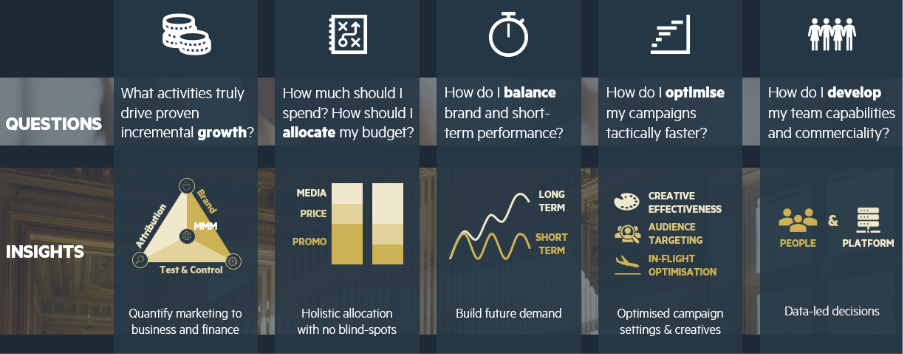
Behind every marketing effectiveness programme sit five recurring questions. They are asked in the boardroom and the planning meeting alike:
- Growth: What activities truly drive proven, incremental growth? How can I prove this ROI to finance?
- Allocation: How much should I spend, and how should I allocate the budget, with no blind spots?
- Brand: How do I balance brand-building and short-term performance?
- Agility: How do I optimise campaigns tactically, at pace?
- Capability: How do I develop my team’s data and commercial fluency?
All five questions need to be supported by a combination of strong data driven insights and strategic alignment across all levels of the business
Force 1 — Speed & Agility
FROM A ONE-OFF STUDY TO ALWAYS ON INSIGHTS
“MMM is too slow and arrives too late” is the most common complaint we hear. Traditional MMM delivers one or two readouts a year, each preceded by resource-intensive data preparation and validation. So insight can land up to six months after a campaign ran, often missing the very budget-planning window it was meant to inform.
The fix is to introduce a multi-speed approach where data can flow through the model at high frequency while hands on model refitting can happen more periodically. Automation requires work but the good news is that it works best for digital channels where campaigns are changed at higher frequency. Compared with TV data which is difficult to automate but campaigns don’t usually require day to day adjustments. Once users get used to the idea that different speeds can co-exist in a unified model framework, the flexibility can be tailored to match the speed of trade and change that fits with planning moments.
Real-time campaign monitoring enables in-flight optimisation, informing investment decisions at the point where spend can be optimised to yield better results now. And more complete model updates can be expedited significantly too because there’s no data collection period to consider when the flow is real time.
The principle is simple: think fast, and think slow. Tactical signals at the speed of the business, resting on rigorous, independent modelling.
Force 2 — Frontier Measurement
HOLISTIC MEANS EVERY LEVER
Marketers need to optimise budget across all their investments. If Measurement covers only paid media channels, as much as 40% of commercial activity can go unmodelled, a blind spot that quietly distorts every allocation decision built on top of it.
The scale of the gap is significant:
- ~30% of US / UK digital ad spend is now retail media
- Influencers and creators absorb over 40% of some beauty marketing budgets
- Creator-economy ad spend grew 26% year on year against 7% for the wider ad market
- Sponsorship represent significant investment that is rarely modelled at all
- Owned and Earned reach plays a growing role in building brand equity, but it’s difficult to capture the effects in the same system as paid media
The newest frontier is generative AI. LLMs are reshaping brand discovery and preference, behaving less like a search tool and more like a decision-making intermediary, a financial adviser, a personal shopper, a concierge. They are broadcasting opinions on your brand whether or not you have an AI strategy, and optimisation for AI discovery (GEO) has advanced faster than measurement.
At Ekimetrics we have incorporated every single one of these factors into MMM, with AI search as the latest lever in the mix. Our clients can view the contribution of organic social content next to online video, next to Sponsorship. And we help them understand what role each of those channels so that there is a balance through the funnel of strong brand consideration and conversion drivers.
Force 3 — Creative Intelligence
THE MOST UNDER-MEASURED DRIVER OF PERFORMANCE
Creative is the single largest source of performance that most brands still exclude from MMM dismissing it as too subjective to quantify. The evidence says otherwise.
60% of YouTube video performance is explained by creative quality
Our independent study with Google found that creative execution explains around 60% of YouTube video performance variance, and that optimising creative quality can lift ROI by up to 2.2×. In that study, 58% of videos were suboptimal, a substantial, untapped opportunity sitting inside existing spend.
Creative can be scored, and most importantly, plugging the scores into MMM helps us prove that it has predictive commercial impact.
Modelling thousands of creatives against their scores reveals how much of campaign ROI is driven by creative strength versus media, seasonality and brand link, and which emotional and executional attributes actually drive conversion. That turns “creative is subjective” into a set of guidelines that reliably raise return.
Force 4 — AI-Powered Effectiveness
PREDICTIVE, GENERATIVE, AGENTIC
AI is changing both how we measure and how we decide, along a clear trajectory. Predictive AI is already inside the models — machine learning for forecasting, optimisation and causal inference that separates true incrementality from correlation. Generative AI lets teams interrogate their models in plain language, generate scenarios and battle plans, and cross-reference social and consumer signals — “just ask”, rather than wait for the analyst.
Contextual intelligence augments MMM with market context, social listening and competitor signal; synthetic panels can pressure-test how customers are likely to react to a new offer or promotion before it launches. Next comes agentic AI: agents that run an analysis end to end, surface the decision, and integrate into the wider marketing AI workflow. The direction of travel is from insight-on-request to decision-support that is always present.
Force 5 — Brighter Decisions
MEASUREMENT ONLY MATTERS WHEN IT MOVES THE DECISION
Five questions we hear from our clients
- The confidence gap, constantly having to prove value to a finance function that does not trust the measurement.
- The ownership divide, accountability for growth without ownership of the full commercial engine.
- The performance-marketing trap, For now, humans still make the final call whatever the model says — so the real work is to earn the decision. That means a data-led decisioning culture, measurement embedded in the actual decision forums (budget, rolling forecast, three-year plan, the weekly sales meeting), and trust built with finance through clarity on what is being optimised for. A single source of A&P truth, a common language and governance, and an execution tracker that monitors realised versus planned ROI on a rolling basis are what turn measurement into decisioning.
From measurement to commercial decisioning
Traditional MMM can feel inadequate in answering these questions when it’s delivered as a static, backwards looking report – providing ROI tables instead of decision ready insights. This results in lack of trust & relevance and ultimately adoption fails.
Operating at the bleeding edge means turning data into decisions 360° commercial decisioning that represents the business fully and speaks the language of key stakeholders.
This does not happen by accident. It requires strong strategic alignment and governance for each team to feel empowered by the data to inform their planning and activations day to day. The prize is concrete — stronger ROI, conversion, customer lifetime value and margin — and, above all, decisions the whole C-suite can trust to build growth.
CONTACT US
Partner & GM Ekimetrics UK
Partner Ekimetrics UK